The National Tree Week running from 27th November – 5th December is the largest annual tree celebration in the UK. Run by the Tree Council, the National Tree Week seeks to inspire the country into nation-wide, tree-planting action with webinars, tree-related arts, cultural events and tree-planting projects.
Why is it so important that celebrations like the National Tree Week take place and gain huge attention? And why should you be trying to get involved?
Carbon Benefits:
We are all now aware of the impacts that the climate crisis is having globally. Global heating, melting ice caps and increased extreme weather events (droughts, floods, tropical storms etc.) have all commanded extensive media attention worldwide. Why? Due to man-made climate change caused by on-going demand, consumption and combustion of fossil fuels generating greenhouse gases (principally carbon dioxide).
So why are trees relevant? Because despite all the money spent on carbon capture innovation, trees remain one of the best methods we have at absorbing carbon dioxide from the atmosphere. A mature tree can draw down over 20 kilograms of CO2 per year, with an acre of forest able to remove the emissions equivalent to roughly 20,000 driving miles annually (tenmilliontrees.org).
Therefore, planting and protecting trees is absolutely essential in the fight against the climate crisis.
Carbon Offsetting*:
Carbon offsetting schemes in the UK can include funding tree planting projects or peatland restoration. Offsetting is an important tool in the fight against the climate crisis when done correctly, but if carried out incorrectly can amount to little more than “greenwashing**”.
Carbon offsets should only be used once all other carbon reduction measures have been implemented and only unavoidable greenhouse emissions remain. Too often companies use carbon offsetting too early to compensate all of their emissions, which avoids the essential behavioral changes needed to become a sustainable, green society.
Another issue facing carbon offsetting is the permanence of their related carbon savings. Taking tree planting projects as an example: when a tree starts absorbing CO2 from the atmosphere we achieve carbon removals, however if that tree were cut down, the initial carbon removal is lost and re-released into the atmosphere.
So new trees not only need to be planted but they must be nurtured and protected, for the carbon offsets to achieve the anticipated levels of carbon dioxide removal.
Biodiversity Impacts:
Another reason to plant more trees as part of National Tree Week is the rich biodiversity and ecological benefits trees bring. The climate crisis is closely paired to the biodiversity crisis with many scientists stating that the world is currently experiencing the sixth major mass-extinction event.
It is now more important than ever before in human history to give nature a home. Many Carbon Charter members have already made positive steps in this regard with wildflower gardens and onsite tree planting, see more of what Carbon Charter members have been getting up to on our Carbon Charter Case Studies page.
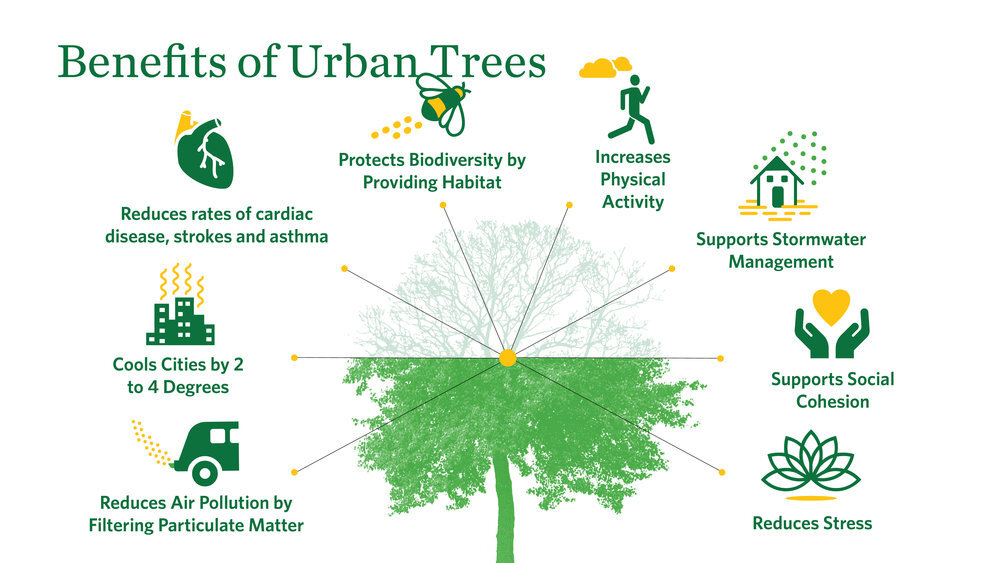
The biodiversity and social benefits of trees in urban areas (image from the Nature Conservancy – nature.org).
Social Impacts:
Planting trees isn’t just something we should do for our planet, it’s something we should do for us.
The act of planting trees is great exercise, whilst also reconnecting us with our natural world. Just being in and around green areas has a proven positive effect on our mental health, reducing stress.
Trees contribute in reducing air pollution, increasing flood defences and intercept pollutants and particulates heading for waterways, sanitizing our water supply.
If the climate isn’t enough of a reason, we should plant trees for ourselves too!
*Carbon Offsetting: A method of compensating for your greenhouse gas emissions by funding carbon savings or carbon removals elsewhere.
**Greenwashing: The practice of making an unsubstantiated or misleading claim about the environmental benefits of a product, service, technology or company practice. Greenwashing can make a company appear to be more environmentally friendly than it really is (edie.net).
Harry Grosvenor – Carbon Charter Assistant, Groundwork East.