
Definition
Engine idling is leaving a vehicle’s engine running while it is stationary.

Credit: Freepik
Why does this happen?
We’ve all probably been guilty of leaving our engine running at some point and it can sometimes be unavoidable e.g. deicing your car or stop start traffic. However, there are also times when it is avoidable, e.g. waiting to pick someone up.
What impact does it have on the environment?
Leaving your vehicle idling whilst stationary emits harmful gases into the air such as carbon dioxide and nitrogen dioxide which contribute to the ongoing climate crisis as well as causing health issues such as asthma and lung disease. Research by the University College Cork found that if drivers stopped idling for 3 minutes every day of the year, carbon dioxide emissions would reduce by 1.4 million tonnes annually. That’s the equivalent of taking 320,000 cars off the road.
How to stop idling?
Many of us want to do our bit for the environment but it can sometimes feel overwhelming. Why not start by trying to stop idling where you can? When your car is stationary, and it is likely you will not move for a minute or longer, turn your engine off in order to reduce the number of air pollutants being released into the atmosphere. Some cars now have a stop-start feature fitted which will do this automatically so make sure that it’s switched on. It is important to note that turning your engine off and turning it on after a minute won’t cause more pollution than idling, this is a common myth.
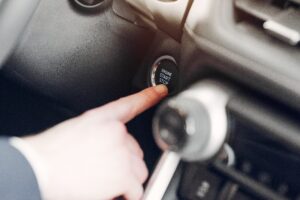
Credit: Freepik
The law
Car idling is not only bad for human health and the environment but it is also illegal, and you could face a penalty if you are caught with your engine running.
Rule 123 of the Highway Code states that:
“You MUST NOT leave a parked vehicle unattended with the engine running or leave a vehicle engine running unnecessarily while that vehicle is stationary on a public road”
If you are caught idling, you could be fined as per the Road Traffic (Vehicle Emissions) Regulations 2002.