
Nuclear fusion became topical to some of the world’s greatest minds in the early 20th century, when there was an inquisition on how stars power themselves. Jump forward a hundred years and scientists around the world are exploring its possibilities to generate energy.
Fission vs Fusion
Both fission and fusion are nuclear processes, in that they involve changing nuclear forces to change the nucleus of atoms.
Current nuclear power stations operate by nuclear fission, which relies on splitting a heavy element, Uranium, into fragments (see figure 1).

Figure 1
Nuclear fusion on the other hand, relies on combining two lighter atoms to form a larger atom (see figure 2).
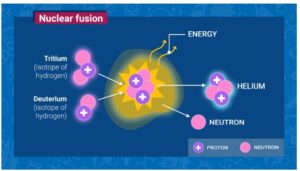
Figure 2
Why the need for change?
Nuclear fission has the disadvantage of generating unstable nuclei; some of which are radioactive for millions of years. Fusion on the other hand does not create any long-lived radioactive nuclear waste. Fusion produces helium, which is an inert gas. It also produces and consumes tritium within the plants enclosed chamber (see figure 3). Tritium is radioactive but it has a short half-life which means its only used in small amounts and exposure cannot produce any serious danger.
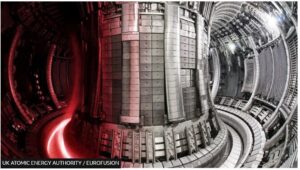
Figure 3
How soon will fusion be readily available?
The UK government announced in 2022 that the West Burton power station in Nottinghamshire has been selected as the home for the UK’s fusion energy plant prototype set to be built by 2040 following various breakthroughs in nuclear fusion energy production. Despite this, nuclear fusion is still in its infancy, with a recent experiment at the UK-based JET laboratory early in the year producing 69 megajoules of energy in over 5 seconds. This amount of energy equates to approximately four to five hot baths.
There are many obstacles still in the way of making fusion a readily available and permanent method of energy generation, such as needing the lining of the enclosed chamber to withstand constant temperatures 10 times hotter than the sun in addition, to the constant movements of neutrons.
Will nuclear fusion make current renewables obsolete?
Nuclear fusion would provide limitless, clean energy once cracked, but that does not necessarily mean current renewables would be obsolete. Fusion will likely not become commercially available for many more decades and the world needs sustainable solutions in the meantime, with many experts anticipating “nuclear fusion may change the world but current renewable energy sources will save it”.