
The history of Electric Vehicles.
In 1832 Scottish inventor Robert Anderson created the first crude electric vehicle (EV) which was powered by non-rechargeable primary power cells. Further developments, including the invention of the lead-acid battery in 1859, meant the first electric car to be powered by rechargeable, high-capacity batteries hit the road in 1884.
During the early 1900’s the EV rapidly rose to popularity due to being a quiet, easy to drive vehicle that didn’t emit any smelly pollutants, and by 1912 EV’s accounted for a third of all vehicles in the US.
So, if electric vehicles were so popular over 100 years ago, what happened?
Cheap and widely available petrol, continued improvements to the internal combustion engine, and Henry Fords mass-produced model T, all aided the soar in sales for petrol powered vehicles and subsequently contributed to the decline in EV interest.
The 1960’s and 70’s, saw fuel prices rise significantly. It was also around this time electric vehicles regained interest when NASA’s Lunar rover, a fully electric vehicle, became the first manned vehicle to drive on the moon.
In 1976, US Congress passed the Electric and Hybrid Vehicle Research Development and Demonstration Act to support the research and development in electric and hybrid vehicles.
The commercialization of the lithium-ion battery by Sony and Asahi Kasei in 1991 was responsible for the development of increased ranges in EV’s.
In 2008 the Tesla Roadstar was delivered to customers as the first road-legal serial production of pure electric cars to use lithium-ion battery cells. It was also the first EV capable of travelling more than 200 miles on a single charge.
In 2016, global sales of pure electric cars and vans passed the one million milestone and in 2023 the UK committed to end the sale of new petrol and diesel cars by 2035.
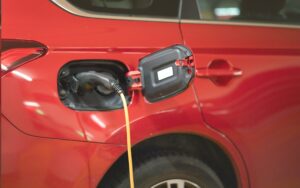
Photo by Michael Fousert on Unsplash
So where do we go from here?
The average range of current EV’s on the market is estimated at 300 miles on a full charge.
With a higher range often translating to a higher price, many consumers are reluctant to make the switch when the average range of a diesel can provide anywhere between 450 and 650 miles on a full tank, with a more established second-hand market allowing for a cheaper price compared to EV’s.
The mining of lithium for the batteries is also cause for concern for its environmental implications, but with regulations encouraging more EV’s on the road and less gas-powered vehicles how are we able to accommodate the ever-common range anxiety in addition to the battery’s severe environmental impacts?
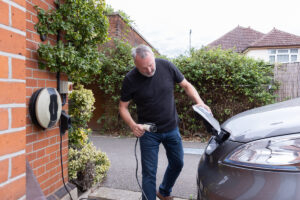
Photo credits – GroundworkEast
Hydrogen vs Solid-State
The current debate is what will be next on the automotive innovation’s itinerary, hydrogen or solid-state?
Hydrogen is the lightest and most abundant element in the universe and contains more energy per unit of weight than fossil fuels. Hydrogen fuel cell vehicles will offer zero tailpipe emissions meaning hydrogen production would be the biggest contributor in the total emissions of the vehicle. The only method of producing zero emission hydrogen is through electrolysis powered by renewable electricity.
The main benefits of a hydrogen vs battery electric vehicles are the quick refueling time and the fuel energy density. Together, and with a developed refueling system, fuel cell EV’s (FCEV’s) could overcome the range barrier in some applications.
Current shortfalls for FCEV’s are they are four to six times less energy efficient than Battery EV’s, there’s a lack of refueling infrastructure and the higher unit cost of producing hydrogen makes it an expensive zero emission option.
But what about solid-state?
Compared to lithium-ion batteries, solid-state batteries offer a smaller and lighter alternative. Their high energy density means more energy can be packed into a smaller space, which allows for a greater battery capacity and thus greater range. Generally speaking the recharge time for a solid-state battery should be significantly faster with many projections offering 80% in 10-15 minutes. Additionally, fewer materials overall are used in the manufacturing process of the solid-state making for a resource-efficient comparison. Finally, there are no flammable liquid electrolytes in a solid-state battery, therefore the risk of fire stays low even at faster charging rates.
There are some drawbacks to the solid-state battery;
The battery is anticipated to use more lithium than todays lithium-ion batteries. With lithium prices tripling as a result of mitigating the risk of resource scarcity.
Recycling is also a consideration as with lithium-ion batteries the graphite and lithium currently cannot be recycled. Offering a closed-loop recycling system for lithium and graphite can ameliorate the risk of reduced resources.
As such with lithium-ion batteries, repeatedly charging the vehicle at rapid rate can increase the likelihood of shorting the battery. As a battery ages, the shape of the lithium electrode changes and grows. The lithium forming are known as dendrites, branching structures that grow into the solid electrolyte. Over time these dendrites grow long enough to reach through the other side of the electrolyte thus shorting the battery.
Illustration by Sabine Kroshel on Pixabay
The future
While all fuel types have their benefits and drawbacks it is clear to see scientists and manufactures are assessing various forms of how future vehicles will be powered with the consideration of the planet in mind. Businesses will need to adopt zero-emissions transport options in the form of cars, vans and HGVs to ensure that they meet their net zero targets, mitigating emissions and the global climate impact.